

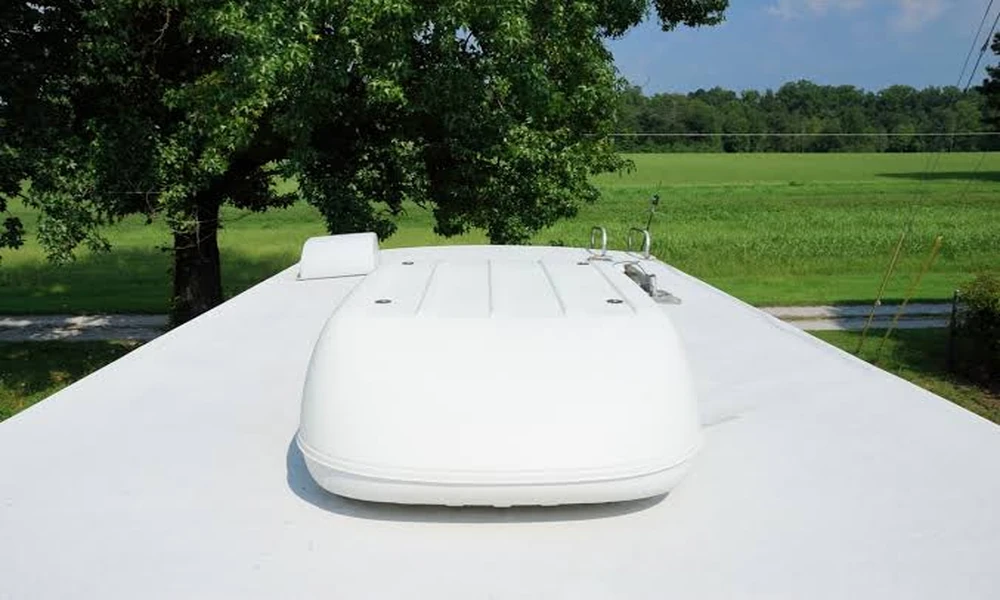
Ask a service writer at any RV dealership what destroys more campers than collisions and you’ll get the same one-word answer, usually with a shrug. Water.
Not a dramatic flood, either. The slow kind. The kind that finds its way in around a vent flange over two seasons, wicks sideways through the plywood-and-foam sandwich overhead, and never announces itself until somebody presses on the ceiling panel near the bathroom and feels it give.
By that point the repair isn’t a tube of caulk. It’s carpentry.
That gap, between a forty-dollar fix and a five-figure one, is really the whole story of RV roof maintenance. Worth understanding before spending money in either direction.
It’s not one surface. It’s a dozen holes.
Most people picture a single sheet up there. It mostly is a single sheet, and the sheet is almost never where trouble starts.
Count the penetrations on a typical travel trailer: two or three vent fans, a skylight, an air conditioner curb, a refrigerator vent, the plumbing stack, an antenna base, solar mounts if the owner added them, plus perimeter trim running the full length of both sides. Every one of those is a hole cut through the membrane, covered by a flange, sealed with a bead of lap sealant that somebody at the factory laid down in roughly ninety seconds on a moving line.
Sealant is a consumable. It’s designed to be. Self-leveling products like Dicor stay flexible for a few years, then they oxidize, shrink a hair, and pull back from the edge of the flange. Park that rig outside in Arizona or west Texas and UV chews through it faster still. Meanwhile the membrane itself might have another decade in it while the joints around the fan have already quit.
So the honest answer to “how long does an RV roof last” is a question back: which part of it did you mean?
Four materials, four ways of getting old
EPDM – the black rubber sheet with a white top layer, still the most common covering on towables. Sacrificial by design. That white surface chalks off over the years, which explains the gray streaks running down the sidewalls after a rain and the powder you get on your palm when you rub it. EPDM is doing its job when it chalks. It’s just doing that job at your expense, because every micron washing off is a micron of thickness gone for good.
TPO – the newer thermoplastic sheet, stiffer underfoot, doesn’t chalk the same way. It does turn brittle at the welds and around fasteners as plasticizers migrate out of the film.
Fiberglass – found on higher-end fifth wheels and Class A coaches. Won’t chalk, won’t tear. But gelcoat crazes, and the panel joints still hang on caulk.
Aluminum – mostly vintage units and a handful of purpose-built haulers. Wonderful metal. Miserable seams.
None of the four is a waterproofing system on its own. Each is a waterproof sheet held together by a maintenance product whose service life is a fraction of the sheet’s.
The resealing treadmill
Here’s the arithmetic that catches owners off guard.
Standard advice says inspect the seals twice a year, reseal what needs it, and recoat the whole membrane with an acrylic elastomeric every three to five years. Nothing wrong with that advice. A full acrylic recoat runs somewhere near $500 to $1,000 at a shop, less if you’re comfortable on a ladder with a roller and a long afternoon.
The catch hides in the word every.
Acrylics are water-based films that cure by evaporation. Thin, reasonably UV-stable, and yes, they keep water out for a while. Tensile strength on that class of product generally sits in the 200 to 400 PSI neighborhood. Maintenance coat, not structural membrane. Nobody in the industry pretends otherwise.
Now stretch that across a twenty-year ownership window. Four to six recoats. Seam work every spring in between. Plus whatever a shop bills to pull and rebed the air conditioner when the goo around the curb finally lets go, which it will. Add the column up and the cheap path stops looking cheap somewhere around year twelve.
Full replacement sits at the other end: $7,000 to $15,000 and climbing, more once there’s rot in the decking. And by the time anybody is quoting replacement, there usually is.
Where DIY still makes complete sense
Plenty of it does. Anyone telling you otherwise is selling something.
Washing the membrane with a non-petroleum cleaner twice a year costs almost nothing and roughly doubles how long the top layer survives. Scraping old lap sealant off a vent flange with a plastic blade and laying a fresh bead is genuinely approachable work – two hours for a first-timer moving carefully, less once you’ve done it twice. Catching a hairline split in a corner molding before it turns into a wet ceiling is the single highest-return thing any owner can do, full stop.
One rule worth taking seriously: never put a solvent-based product over an incompatible substrate without checking first. Petroleum distillates and EPDM do not get along, and there are a lot of forum posts written by people who found that out the expensive way. Bookmark the resources that walk through those compatibility questions specifically. RV fixes is one of the more practical ones. ArmorThane’s rv roof repair guide goes further into the inspection sequence and the repair-versus-replace call than most manufacturer literature bothers to.
Do the small stuff. It buys years.
The other option: spray the whole thing as one piece
For owners who are tired of the treadmill, a different approach has been migrating over from the industrial side of the coatings business. Spray the entire deck, penetrations and all, as a single continuous membrane with no joints anywhere in it.
The chemistry is polyurea. Two components, an isocyanate and an amine-terminated resin, and the reaction between them runs so fast that the material gels within seconds of leaving the gun. That speed is the entire point. It lets the film build on a vertical flange or an upside-down edge without sagging, and it means the whole thing goes down in one pass, so there’s no lap, no overlap, and nowhere for water to work its way underneath later.
Performance sits in a different category from acrylic. Tensile strength on a sprayed polyurea membrane typically lands between 3,000 and 5,000+ PSI with 300 to 600 percent elongation, applied around 60 to 80 mils thick. Translated: it stretches with the structure as the rig flexes down a washboard road, it doesn’t crack at 15 degrees, and it doesn’t chalk away every summer. Reflective white formulations knock down the heat load too, which anybody who has run a rooftop A/C through a July afternoon will appreciate.
Professionally applied rv roof coatings in that class generally price between $3,500 and $7,000 depending on the length of the rig and how much prep the old surface demands. Real money. But it’s one number instead of a recurring one, and set against four rounds of acrylic plus a decade of chasing joints every spring, the math tends to close inside ten years.
Two caveats, said plainly. This is not a driveway project – proportioning equipment runs hot and high-pressure, and the mix ratio has to hold inside tight tolerances or the film simply won’t build right. And prep matters more than the chemistry does. A membrane sprayed over chalky, uncleaned EPDM will look flawless and fail at the bond line, which is precisely the sort of failure nobody sees coming.
Which camp is your rig in?
Quick triage, roughly what a tech would actually look at.
Membrane sound, joints intact, rig under about eight years old? Stay on maintenance. Clean it, inspect twice a year, reseal what needs it, budget for an acrylic recoat when the surface starts chalking noticeably.
Joints opening faster than they used to, or two recoats already in the history, or a soft spot anywhere? Get a real inspection before deciding anything at all. Soft decking has to be repaired before any coating goes over it. Coatings don’t fix rot. They hide it.
Rig you plan to keep, structure sound, but the maintenance cycle has become a chore you resent? That’s the case where a one-and-done membrane earns its money.
The part almost everybody skips
Whichever route makes sense, the calendar matters more than the product does.
Inspect in spring, again in fall. Walk it if the deck is rated for weight, or use a ladder and a phone on a selfie stick if it isn’t. Look specifically at the uphill side of every flange, because that’s where water sits and waits. Check the front cap joint. Check the ladder mounts. Photograph the same six spots each time so there’s something to compare against next season.
Ninety percent of catastrophic RV water damage started as something visible that nobody looked at for two years. Roofs give plenty of warning.
They just don’t give it loudly.
