

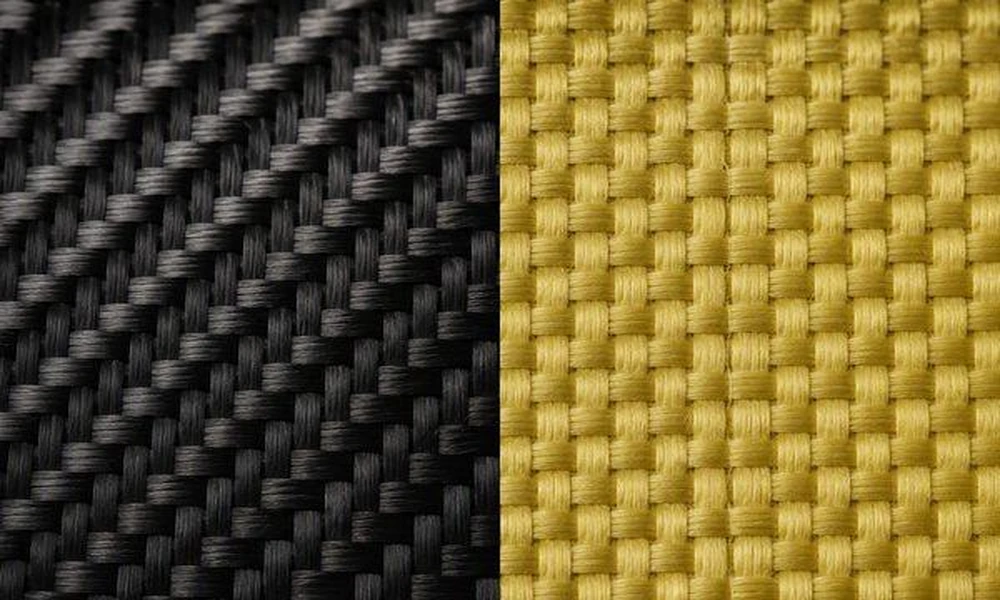
Carbon fiber and Kevlar look similar on a shelf. They behave very differently on the car.
Most people shopping for composite parts ask the wrong question first: which material is stronger? It sounds simple, but “stronger” has at least four meanings in a car part. Stiffness. Pulling strength. Impact survival. Compression. Carbon fiber and Kevlar each win some of these, and neither wins all of them.
A better question is this: how is the part most likely to get hurt? Answer that honestly, and the material usually picks itself.
Two Materials, Two Personalities
Carbon fiber is the stiff one. Its fibers run like tiny graphite rods, which is why a carbon hood feels rock solid when you press on it. The trade-off is that carbon fails suddenly. Push it past its limit and it cracks or shatters, sometimes with hidden damage inside the laminate that you only find later.
Kevlar is the tough one. It is a para-aramid fiber, the same family used in ballistic vests. It stretches two to four percent before it breaks, roughly double what carbon manages, so it absorbs a hit strand by strand instead of snapping all at once. If you want the full numbers side by side, there is a detailed carbon Kevlar vs carbon fiber comparison with test data worth a look.
One more myth worth killing: Kevlar is not the lighter option in practice. The raw fiber is slightly lighter than carbon, sure. But because carbon is so much stiffer, you need less of it to make a part that holds its shape. At equal stiffness, the carbon part usually ends up lighter on the scale.
Pick by Failure Mode, Not by Spec Sheet
Think about what the part will actually face on your car:
- Aero and body panels – hoods, wings, trunk lids. These parts hate flex. A hood that bends at speed feels cheap and can flutter. Stiffness rules here, so carbon fiber is the right call.
- Strike zones – splitter leading edges, rocker panels, lower bumper lips. Gravel, winter sand, parking blocks, track debris. These parts get hit again and again. Kevlar’s impact absorption earns its keep here.
- Underbody and endurance use – undertrays, rally and off-road panels, endurance racing bumpers. Repeated hits plus vibration plus heat cycles. This is where a hybrid weave makes the most sense.
- Show builds – if the car lives on smooth roads and the part is mostly visual, plain carbon wins on finish and cost. Spend the money on weave quality instead.
What It Feels Like on the Road
Picture a stone kicked up at highway speed. On a carbon fiber splitter, that hit can leave a star-shaped crack, and the damage often runs deeper than it looks. The part might survive the day and fail a month later, because delamination inside the laminate keeps growing quietly.
The same stone hitting a Kevlar-blend panel leaves a scuff. Maybe a small dent you can see and judge with your own eyes. That is the underrated benefit of aramid: failures are honest. You get warning, and warning means you can finish the trip, the race, or the season before spending money.
Neither behavior is “better” in the abstract. A time-attack wing that must not flex at 150 mph belongs in carbon. A gravel-rally skid plate that takes hits every stage does not. Match the material to the abuse, not to the marketing photo.
So What Is the Black-and-Gold Weave?
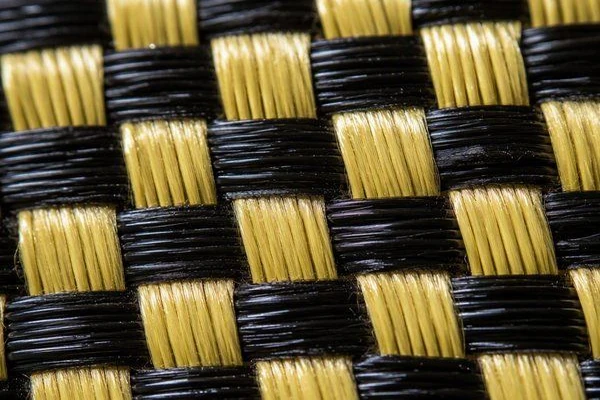
Carbon Kevlar hybrid fabric: black carbon threads and golden aramid threads in one weave.
The checkered black-and-gold fabric you see on some parts is carbon Kevlar, a hybrid weave. Carbon threads run one way, golden aramid threads the other. The idea is simple: keep most of carbon’s stiffness, borrow some of Kevlar’s forgiveness.
In practice, a hybrid part stays rigid enough for bodywork but is far less likely to shatter when something hits it. The failure mode changes from a sudden crack to a gradual, visible denting that gives you warning. For a splitter that kisses a curb or a bumper that eats gravel for eight hours of endurance racing, that difference is the whole point.
There is a small bonus on the repair side too. Because hybrid parts tend to deform instead of explode, minor damage can often be assessed, sanded back, and refinished rather than written off. Ask your supplier how the part behaves before you buy, not after the first incident.
It is also just a good-looking fabric. If weave appearance is a big part of your build, it is worth comparing it with other options like forged carbon fiber, which takes a completely different approach to looks and structure.
Cost and Care: the Part Nobody Mentions
Here is something that surprises buyers: raw Kevlar fiber actually costs more than standard carbon fiber. Expect roughly $15 to 25 per pound for aramid against $10 to 20 for carbon. Hybrid parts carry a premium on top, because two fiber types in one layup means more careful work in the mold.
Do the math over a season, though, and the premium often pays for itself. A cheap carbon splitter that shatters twice costs more than one hybrid splitter that scuffs and keeps going. Replacement, shipping, and downtime add up faster than fabric ever will.
Kevlar also has two habits you should know about before you buy. First, it hates sunlight. Leave aramid fibers exposed to UV and they weaken, so Kevlar and hybrid parts need paint or a proper coated finish. Second, it is miserable to trim. The fibers fray instead of cutting cleanly, so edges and holes need special blades and patience. How a part is made matters as much as what it is made from – the difference between dry carbon and wet carbon layups, for example, will affect weight, finish, and price more than the fabric choice alone.
The Bottom Line
Stop asking which material is stronger. Ask what will try to kill the part:
- Flex and flutter are the enemy → carbon fiber.
- Rocks, debris, and repeated hits are the enemy → Kevlar or hybrid.
- Both at once, or one expensive part you cannot replace mid-season → hybrid weave.
Get that one decision right and the rest – weave pattern, finish, supplier – becomes much easier.
