

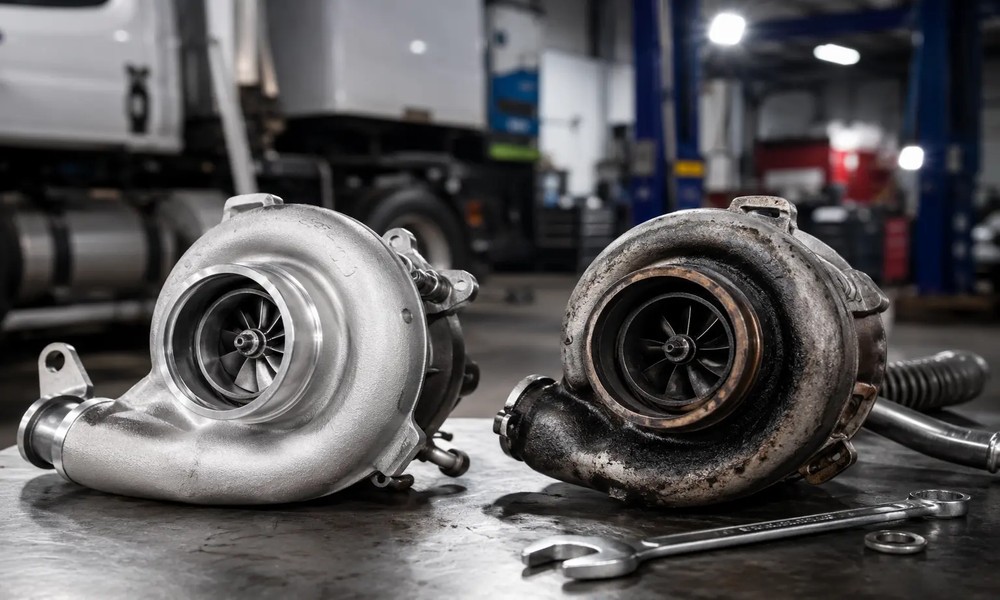
Not all diesel repairs are created equal. Some are unpredictable – wear items that fail without warning despite proper care. Turbocharger failures are not in that category. More than 90 percent of turbocharger failures on commercial diesel trucks trace back to three controllable causes: oil starvation, oil contamination, and foreign object ingestion. Every one of those failure modes is preventable with the right maintenance habits. The expense of getting it wrong is not – replacing a failed Class 8 turbocharger runs $2,500 to $8,000 in parts and labor, plus three to five days of downtime.
This guide covers what truck owners and diesel technicians need to understand about turbocharger function, failure patterns, inspection procedures, and the specific maintenance practices that extend turbo service life to and well beyond 500,000 miles on heavy-duty equipment.
How Diesel Turbochargers Work – and Why Maintenance Matters So Much
A turbocharger recovers energy from exhaust gases that would otherwise leave through the tailpipe as wasted heat. Exhaust flow spins a turbine wheel on one end of a central shaft; a compressor wheel on the opposite end draws in fresh intake air, compresses it, and forces it into the combustion chamber. More compressed air means more oxygen for combustion – which is how a turbocharged diesel generates significantly more power than a naturally aspirated engine of the same displacement.
The engineering challenge is that the turbocharger shaft spins at 100,000 to 150,000 RPM under load, supported by a bearing system that operates on a film of pressurized engine oil roughly two to four thousandths of an inch thick. Turbine inlet temperatures on a loaded Class 8 diesel can exceed 1,400°F. That oil film is doing double duty – lubricating the bearings and carrying away heat simultaneously. When that oil is degraded, restricted, or absent even briefly, bearing wear begins immediately and compounds with every operating hour.
The practical implication is that turbocharger health is almost entirely a function of oil quality and delivery. Engines with disciplined maintenance programs routinely reach and exceed the manufacturer’s overhaul interval without turbocharger replacement. Engines with extended drain intervals, poor filtration, or improper startup and shutdown procedures rarely do.
The Three Failure Pathways – and How to Block Them
Understanding how turbos fail is the foundation of preventing those failures. The three primary failure pathways each have specific maintenance responses.
Oil starvation happens when the turbo doesn’t receive adequate oil pressure or volume. The most common scenario is a cold start on a truck that has sat overnight or longer. Oil drains from the turbo’s center housing back to the sump during shutdown; at startup, there’s a brief window before pressurized oil reaches the bearings. On a healthy system with fresh oil, this window is short – typically one to three seconds. On a system with a worn oil pump, clogged feed line, or degraded oil that takes longer to flow at cold temperatures, the unlubricated window extends – and repeated cold starts accumulate bearing damage over time.
Oil contamination is the most widespread turbocharger killer in commercial fleets. Diesel combustion produces soot, carbon particles, and acids that are suspended in the lubricant from the first moment of operation. A properly maintained engine with quality filtration and correct service intervals keeps these contaminants within acceptable limits. Extended drain intervals, inadequate filtration, coolant contamination from a leaking EGR cooler, or fuel dilution from short-trip operation all accelerate oil degradation faster than the drain interval accounts for – and contaminated oil carries abrasive particles directly through the center housing with every revolution.
Foreign object damage (FOD) to the compressor wheel is the most dramatic failure mode. A fragment of debris – a fastener, a piece of deteriorated intake duct, grit from a torn air filter – passes through the intake tract and strikes compressor wheel blades spinning at over 100,000 RPM. The result is typically immediate and catastrophic: blade damage, severe imbalance, and bearing failure from the resulting shaft deflection. FOD is entirely preventable through consistent air filter inspection, proper intake duct maintenance, and care around the turbocharger inlet during any engine work.
Early Warning Signs Every Truck Owner Should Know
Diesel turbochargers rarely fail without warning. Most developing turbo problems announce themselves four to eight weeks before complete failure – a wide window for intervention. The challenge is building the observation habits and driver reporting protocols that catch these signals early.
Exhaust smoke color change is the most reliable visual indicator. Blue or blue-grey smoke at startup or during deceleration signals oil migrating past worn turbo seals into the exhaust stream. This symptom deserves immediate investigation – not only because of the turbocharger itself, but because oil-contaminated exhaust accelerates diesel particulate filter plugging, and a single unaddressed turbo failure can destroy a $3,000 to $5,000 DPF.
Audible changes in turbo behavior are equally telling. A healthy turbocharger produces a characteristic whooshing sound during acceleration. A high-pitched whine or siren-like tone that increases with RPM typically indicates worn shaft bearings allowing shaft deflection. Grinding or rattling noises suggest more advanced bearing failure. Whistling at various throttle positions often points to air leaks in the charge air system – cracked intercooler piping, loose couplers, or damaged intake tubing – that reduce boost pressure and put additional load on the turbo to compensate.
Power loss under load and elevated oil consumption are the third cluster of warning signals. A turbo not building full boost will feel lazy on grades and require more throttle to maintain speed. Oil consumption above roughly one quart per 1,000 miles – or a noticeably faster-than-normal dipstick drop between checks – often indicates turbo seal deterioration weeks before smoke is visible.
Hands-On Inspection Procedures for the PM Schedule
Integrating turbocharger inspection into every PM service interval is the most practical way to catch developing problems before they become road failures. The inspection takes less than 15 minutes and requires only tools already in any diesel shop.
Shaft play assessment is the core check. With the engine cold and off, remove intake piping to access the compressor wheel inlet. Grasp the compressor wheel carefully – avoiding direct contact with blade edges – and check for radial play (side-to-side movement) and axial play (in-and-out movement). Any perceptible grinding or roughness during radial movement indicates bearing wear. While the inlet is open, inspect compressor blade condition – nicks, bending, erosion, or oily deposits are all grounds for further diagnosis.
Oil feed and drain line inspection is frequently overlooked and disproportionately important. The feed line – a small-diameter line from the main oil gallery to the turbo center housing – should be inspected at each service for kinks, carbon buildup at the inlet fitting, and secure connections. A partially restricted feed line reduces oil delivery to the bearings without triggering a dashboard warning, because main gallery pressure remains normal. The drain line, which returns oil from the center housing to the sump by gravity, must remain unobstructed – any restriction causes oil backup that overwhelms the shaft seals and pushes oil into both the intake and exhaust streams.
Boost pressure verification with a basic scan tool rounds out the practical inspection. Monitor live boost data during a loaded road test and compare against the manufacturer’s specification for the RPM and load condition. A structured approach to diesel engine diagnostics that integrates turbocharger boost data with EGR, fuel system, and aftertreatment readings gives shops the full engine health picture – turbocharger problems rarely develop in isolation from the surrounding systems.
VGT Turbochargers: The Additional Maintenance Requirement Most Owners Miss
Variable geometry turbochargers (VGTs) – standard equipment on emissions-compliant diesel engines since the mid-2000s – introduce a maintenance requirement absent from fixed-geometry designs. Movable vanes inside the turbine housing adjust exhaust flow angle to optimize boost across a wide RPM range. Over time, carbon deposits from combustion byproducts accumulate on the vanes and their actuator surfaces.
In moderate accumulation, sticking vanes produce fault codes and may illuminate the check engine light. In severe cases, vanes freeze in position – causing the engine to either over-boost (vanes stuck fully closed) or under-boost (vanes stuck open), both of which trigger protective derate modes that leave drivers unable to maintain highway speed. High-mileage fleet equipment should incorporate periodic VGT vane cleaning as part of the major service interval, with electronic actuator range-of-motion verification after cleaning using a scan tool.
VGT actuator failure is a common maintenance item that is frequently misdiagnosed as internal turbocharger failure – a costly mistake. A failed actuator manifests as slow vane response, a stuck position, or a position sensor fault. Replacing a serviceable actuator is a fraction of the cost of replacing the entire turbocharger assembly, and distinguishing between the two requires only a scan tool and a functional understanding of how the system operates.
The Preventive Maintenance Practices That Actually Extend Turbo Life
The maintenance variables that most directly determine turbocharger service life are oil quality, oil change discipline, air filtration, and startup and shutdown procedures – not exotic additives or specialized products.
Oil change intervals should be determined by the engine manufacturer’s specification for the actual duty cycle, not by general custom or cost reduction targets. High-load operation, frequent idle time, extreme ambient temperatures, and short-trip use all accelerate oil degradation faster than standard intervals account for. Oil analysis programs – available from lubricant suppliers and independent labs – measure actual oil condition parameters (viscosity, soot level, metals content, total base number) and allow drain intervals to be calibrated to actual degradation rates.
For any turbocharged diesel engine, the maintenance framework that matters most is the one that governs every service interval. Heavy Duty Journal’s complete guide to diesel truck preventive maintenance covers service interval structures for Class 7 and Class 8 equipment – including the A, B, and C service framework that fleet operators use to sequence oil changes, filter service, and major system inspections in a way that keeps maintenance costs predictable and components protected.
Air filter service intervals depend on the operating environment more than mileage. Modern trucks equip air intake restriction indicators – mechanical gauges or electronic sensors – that measure actual filter restriction and signal when service is genuinely needed rather than relying on fixed mileage thresholds. After every air filter service, inspect all intake duct connections from the filter housing to the turbocharger inlet for secure seating, undamaged clamps, and absence of cracks. A loose clamp allows unfiltered air to bypass the filter entirely and reach the compressor wheel directly.
Startup and shutdown procedures are operational habits that compound over hundreds of thousands of miles. On cold starts, a 60 to 90 second idle allows oil pressure to establish and oil temperature to begin rising before load is applied – protecting bearings during the window when oil delivery is slowest relative to shaft speed. After sustained high-load operation – a long highway pull, a steep grade descent, extended PTO use – a two-minute idle before shutdown allows turbo speed to drop and oil to continue flowing while temperatures normalize. Immediate shutdown after hard driving stops oil flow while the turbine is still spinning and hot, cooking residual oil in the center housing into solid carbon deposits that restrict future oil delivery.
Repair vs. Replacement: The Decision Framework
When a turbocharger requires service beyond inspection and cleaning, the repair-or-replace decision carries meaningful cost and reliability implications.
Remanufactured turbochargers represent the standard cost-effective choice for most fleet replacement decisions. Core exchange programs from OEM suppliers and established remanufacturers provide units tested to original boost and efficiency specifications, with warranty coverage comparable to new. For common applications – Cummins, Detroit, PACCAR, Volvo – remanufactured cores are typically available within the dealer network and major aftermarket distributors at 40 to 60 percent of new OEM pricing.
Cartridge (CHRA) replacement – installing a new center housing rotating assembly into the original turbine and compressor housings – is a cost-effective middle-ground option for shops with turbocharger rebuild experience. It addresses worn bearings and seals while retaining serviceable housings, but requires careful inspection of both housing bores for wear before installation.
Before any turbocharger replacement, address the root cause of the failure. A new turbo installed into a system with contaminated oil, a restricted feed line, or a partially blocked drain line repeats the failure within tens of thousands of miles. The root cause analysis step is not optional – it is the step that determines whether the repair is a one-time event or the first in a recurring series.
The Bottom Line
Turbocharger failures are expensive, disruptive, and – in the large majority of cases – preventable. The root causes that account for more than 90 percent of failures are maintenance variables under direct operational control: oil quality, oil change discipline, air filtration, cold-start and shutdown habits, and systematic inspection at every PM service.
Fleets and individual operators that treat turbocharger health as a first-class maintenance priority consistently reach and exceed the engine overhaul interval without turbo replacement. Those that don’t treat it that way consistently replace turbos at 200,000 to 300,000 miles and wonder why. The maintenance practices that protect turbochargers are the same ones that protect every other expensive engine component – they just carry higher consequences here, because the operating conditions are more extreme and the failure costs are higher. Build those habits into every service interval, and the turbocharger largely takes care of itself.
